Leave Your Message

Top 10 Labeling and Packaging Automation Solutions for Business?

In today's competitive market, businesses must streamline their operations to succeed. Labeling and packaging automation is a pivotal solution that enhances efficiency and reduces costs. This technology helps companies meet rising consumer demand while maintaining quality. With the right automation tools, businesses can manage the entire packaging process with precision.

Selecting the best labeling and packaging automation solutions can be daunting. There are numerous options available, and not all will fit every business model seamlessly. Companies must weigh their specific needs against the myriad of solutions on the market. Investing in the right technologies can significantly impact productivity and brand perception. Yet, many businesses struggle with implementation and integration.

While automation promises many benefits, there are areas requiring careful consideration. Every solution comes with its challenges, from setup costs to training staff. Businesses must remain vigilant in adapting to these technologies. The ultimate goal is not just to automate but to enhance overall operational effectiveness and customer satisfaction.
Top 10 Labeling and Packaging Automation Solutions for Business?

Understanding Labeling and Packaging Automation Needs for Businesses

In today's fast-paced market, understanding labeling and packaging automation needs is vital for businesses aiming to improve efficiency. Many companies face challenges related to outdated processes. The average cost of manual labeling can reach 10% of total production time. This inefficiency can lead to delays and increased labor costs.

Adopting automation can reduce labor costs by around 30%. A report from the Packaging Machinery Manufacturers Institute highlights that businesses implementing automation see productivity increases of up to 50%. However, not all automation solutions are tailored to specific needs. Many organizations struggle with systems that do not integrate well with existing workflows. Investing in the right technology can be daunting.

Businesses must evaluate their unique requirements. For instance, multi-format packaging lines require flexible solutions to meet varying demands. An inflexible automated system could not only waste resources but also restrict future growth options. An optimal balance between automation and manual processes may actually enhance overall productivity.

Top 10 Labeling and Packaging Automation Solutions for Business

Solution Name Key Features Industry Applicability Estimated Cost User Rating
Automated Label Applicator High-speed application, adjustable settings Food & Beverage, Pharmaceuticals $10,000 - $20,000 4.5/5
Case Sealer Automated sealing, adjustable height E-Commerce, Retail $5,000 - $15,000 4.2/5
Shrink Wrap Machine Energy efficient, various sizes available Consumer Goods, Electronics $8,000 - $25,000 4.3/5
Label Printing Software Custom design, batch printing Logistics, Warehousing $2,000 - $5,000 4.6/5
Fill and Seal Machine Multi-purpose, high capacity Food Processing, Chemicals $15,000 - $50,000 4.4/5
Automatic Wrapping Machine Versatile wrapping, user-friendly Manufacturing, Retail $7,000 - $22,000 4.1/5
Barcode Scanner Integration Seamless integration, real-time tracking Warehousing, Retail $1,500 - $4,000 4.7/5
Custom Labeling Machine Tailored solutions, fast operation Beverage Industry, Cosmetics $12,000 - $30,000 4.5/5
Pack Out Automation Speed optimization, minimal labor Pharma, Food Packages $25,000 - $70,000 4.4/5
Smart Packaging Solutions Integrated sensors, sustainability Health Care, Cosmetics $18,000 - $40,000 4.8/5

Key Benefits of Implementing Automation Solutions in Operations

Automation solutions in labeling and packaging bring numerous benefits that improve operational efficiency. By streamlining processes, businesses can reduce errors associated with manual tasks. Automation not only speeds up production but also ensures consistent quality. This helps in enhancing customer satisfaction and brand reputation.

Implementing these solutions offers significant cost savings over time. With reduced labor costs and lower waste levels, companies can boost their profit margins. Moreover, automation helps in compliance with industry standards by ensuring accurate label information and packaging specifications.

Tips: Always assess your current processes before adopting new technologies. Understand your team's strengths and weaknesses. This reflection can guide you in selecting the right automation tools. Also, consider gradual implementation. It allows teams to adapt and reduces the risk of disruption. Regular reviews of these systems can help identify areas for further improvement.

Overview of Leading Labeling Automation Technologies in the Market

Top 10 Labeling and Packaging Automation Solutions for Business?

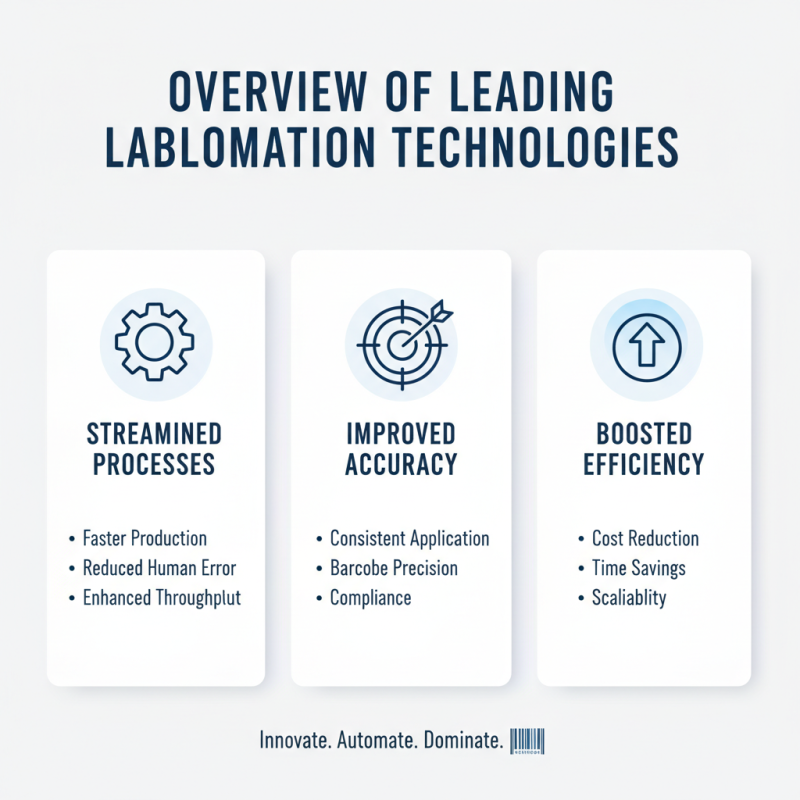
In the realm of modern business, labeling and packaging automation solutions are increasingly vital. Various technologies streamline processes, improve accuracy, and boost efficiency. These solutions address the growing demand for faster production and compliance with industry standards. Automated labeling reduces human error and enhances throughput, which is necessary for maintaining competitiveness.

Different systems are available, each with specific features. Some focus on high-speed labeling for large-scale operations. Others emphasize flexibility, catering to varied product sizes and shapes. Advanced sensors and vision systems ensure that labels are applied correctly, reducing waste. Integration with existing production lines is also crucial for seamless operations. Companies often face challenges in choosing the right system for their unique needs.

Despite advancements, not all solutions meet expectations. Issues such as equipment compatibility and maintenance costs can arise. Businesses should conduct thorough assessments before committing to any technology. Engaging with industry experts can provide insights into the effectiveness of different automation technologies. Testing and validation are essential steps in achieving desired outcomes.

Comparative Analysis of Packaging Automation Systems

Automation in packaging is transforming the way businesses operate. Various systems now cater to diverse packaging needs. However, not all solutions are created equal. Each system has its strengths and weaknesses. For instance, some may excel in speed, while others focus on precision.

A comparative analysis reveals key differences among packaging automation solutions. Some systems are highly adaptable, working well with different products and sizes. Yet, they may require more time to set up initially. Other options offer quicker installation but may lack flexibility. This trade-off can complicate decision-making for businesses. It is vital to evaluate specific packaging requirements before choosing a solution.

The effectiveness of these systems also hinges on user training. Employees must be well-versed in operating the technology. Inadequate training can lead to inefficiencies and errors. Additionally, system maintenance can present challenges. Regular upkeep is crucial for optimal performance, yet it often goes overlooked. Tailoring automation strategies to individual company needs remains essential for lasting success.

Future Trends in Labeling and Packaging Automation Solutions

The landscape of labeling and packaging automation is evolving rapidly. Businesses are experiencing pressure to enhance efficiency and reduce costs. Future trends indicate a shift toward smart automation. This includes the integration of artificial intelligence and machine learning. Companies are recognizing the potential for predictive maintenance. Such technologies can minimize downtime and optimize performance.

Sustainability is another crucial consideration. More businesses are adopting eco-friendly materials and practices. This trend reflects growing consumer awareness about environmental issues. However, transitioning to sustainable solutions often presents challenges. Companies need to balance cost and impact. There's also the need for industry standards in sustainable labeling.

Customization is gaining traction too. Consumers increasingly expect personalized packaging options. Automation technologies facilitate small batch sizes without sacrificing efficiency. Yet, some businesses struggle with implementing these technologies seamlessly. Reflecting on these imperfections can lead to improved strategies. Overall, as the industry advances, businesses must stay adaptable and open to innovation.